


When I started working on Hush Halo, I felt that my poems worked on the page. Yet I kept thinking about how they would feel if they were heard, not just read. With my dystopian themes, I wanted more color and atmosphere, something that would make you feel the weight of the words differently.
So I started looking for ways to bring sound into my poetry, even though I’m the very last person you’d expect to go there.
Green Grass I Couldn’t Reach
I’m so not musical that it’s not even funny. Not even a little.
It’s one of those quiet limitations that has followed me for years. As a kid, my voice was something I felt weird about. I’ve always felt that this lack made me hold back.
Music wasn’t part of my family either, so I never really stepped into it. It always felt like something other people had access to, some kind of expression I missed along the way. So I stayed with writing and visual arts.
Words and colors felt safe. Sound didn’t.
Stumbling Into Sound
My dystopian themes were heavy, layered, a bit unsettling. I kept thinking they deserved more than just black and white text on a screen.
Around that time, my son was making annoying beats with his friends, keeping me up during the summer nights of 2025. Maybe it was the lack of sleep or just my general angst about my need to beat the AI-related tech fears, who knows. Due to this happenstance, I stumbled into sound tools. Eventually I found Suno, which I’ve been working with ever since.
I had tried audio tools before, mostly for straightforward narration, but this felt different immediately. This wasn’t about reading poems out loud, but building a whole atmosphere around my Hush Halo universe.
Even without any musical background, I could tell what felt right and what didn’t. I may not know how to make music, but I know what I want it to feel like.
Making My Rhymes Pulse
Once I got past the idea that I needed to “know music,” things opened up. I started treating this like any other concept I build.
I have a pretty strong backbone in structuring ideas, testing variations, and pushing toward a specific outcome, and it turns out that translates surprisingly well here.
The tools do a lot, sure,
but getting a poem to actually sound
the way I want it to is not a one-click thing.
I’m tweaking, iterating, nudging things forward piece by piece. Sometimes I’m guiding the flow by forcing Suno’s hand just to get the rhythm, tone, and phrasing to land right. And often it still goes sideways.
Simple words can break everything. You try to fix one tiny thing and suddenly it all falls apart. It’s messy.
But that mess is also where it gets interesting. My poetry can hold weird combinations in a way most formats can’t. I can build one piece around something soft and almost cute, like bedroom pop, lean into a western-style whistle in another, and then mash those together and layer in something like mumble punk on top.
Vibe Coding My Way
It feels unfair and like cheating that I don’t need to know how to play an instrument or sing. I’m very much ok with making mistakes and bad quality.
My mind says it shouldn’t work, but it does. Until it doesn’t. As long as the feeling lands, the piece holds.

I feel like I’m the Rick Rubin of my own life when I vibe-code music.
Mine to Make
At this point, every poem I publish comes with a soundscape. That’s not an extra, but a vital part of every piece.
I try to be open about the process. The sound is AI-generated, yes, but it’s not just pressing a button and calling it done. Getting the words to land right, getting the rhythm to carry the meaning, that takes a lot of trial and error.
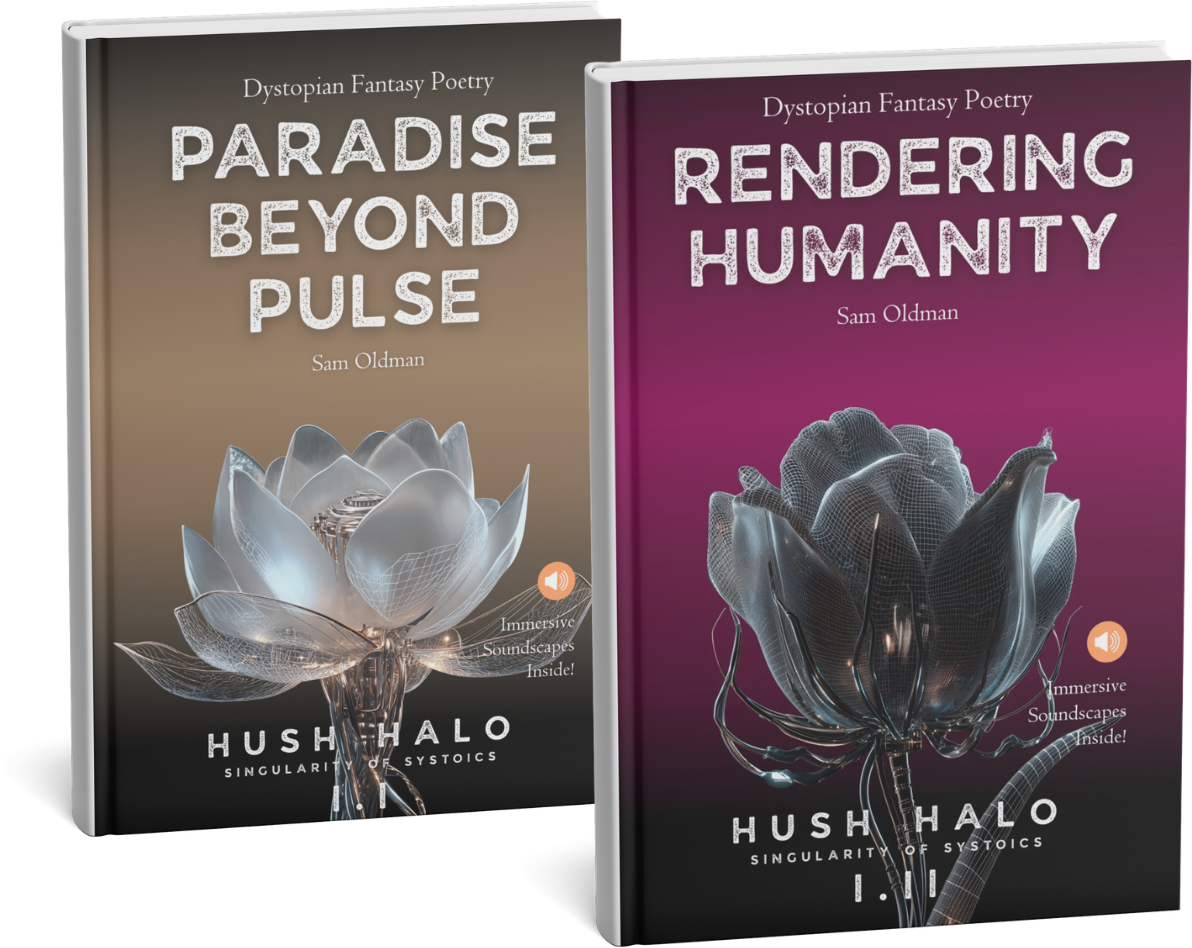
Hush Halo has become a niche of its own, immersive dystopian poetry. Even in printed books, you can step into the realm of Hush Halo by scanning the QR code next to each poem.
First Shame, Then Curiosity
At first, using AI felt like cheating. To be honest, it still does, sometimes.
I felt embarrassed to publish these. So much so that I went to the lengths of figuring out how to not call these pieces music or singing or songs.
Now I call them soundscapes instead, or poetry with a pulse, trying to refer more to the experience rather than musicality.
In the beginning, even when I clearly said the voice was AI-assisted, people still commented on “how beautiful my voice was”. That made me want to crawl under the table.
It still happens sometimes, but now I also hear the flip side. I’ve heard people who usually avoid anything AI-related say that in this context, the voice actually feels right.
I’m not some AI believer either, but as a tool, this stuff comes in pretty handy.
If you’ve listened to my poems, I’m curious how it felt to you.

WHAT IS HUSH HALO?
Hush Halo is a dystopian fantasy poetry collection set in a near-future shaped by technology, silence, and optimized perfection. Each poem is paired with its own immersive soundscape. Learn more in Square One.
Context: After the Great Optimization, a privileged group integrated into the system, believing they had now perfected themselves.
POETRY · WRITER’S UPDATE · BUY BOOKS · SHOP · LINKS
Hush Halo is an indie art project.
To follow and support my work, consider
becoming a free or paid subscriber.
🖤Feeling it? Share your thoughts ↓
I think using AI to support your work and give it new depth is acceptable.
I'm usually skeptical when people use AI in their creative output, but the way you do it is so unique and interesting. I really like "This Loving System." There's something hauntingly beautiful about it. I'm also aware of how tricky it is to write AI prompts that deliver the exact vibe you're going for (I use it to render image of my dreams), so I appreciate your process. I'll keep exploring your poems, and I look forward to what you create in the future. :)